Workshop with Payal Parekh and Jayda Sauseng. The Workshop is in the past. Thanks to everyone attending and the facilitators! On this page we publish some of the materials and sparks from the Workshop.
Content Short
This online workshop discussed how a shift towards mutual aid, cooperative networks for collective action to meet the needs of a community for common benefit, could be indispensable for withstanding climate disasters justly. It would likely also strengthen solidarity and accountability within society. But what could this look like?

Workshop Journal
The workshop was kicked off by introducing the project and the facilitators, setting the stage for an open and welcoming atmosphere. As each participant shared their unique background and burning questions about the topic we started with an intense learning session.
To spark our collective thinking, we explored what words like “disaster,” “collapse,” “vulnerability,” and “crisis” can mean and together, we untangled their similarities and differences, even challenging how these terms are used in politics. It soon became clear: our emotions are deeply woven into these concepts.
We didn’t just talk about feelings—we made space for them. After discussing how our bodies react under stress, we dove into a trauma-informed perspective. Then, it was time to get our bodies even more to the space. Participants chose to express their connections to disasters, climate anxiety, and vulnerability through dance, drawing, poetry, or silent meditation. This powerful, holistic exercise reminded us on the necessity to find different ways to deal with these emotions, and in the reflection it became clear that no one should face these emotions alone—collective support is essential.
Next facilitator Payal Parekh led us into the world of mutual aid. We examined two real-life case studies: The devastating floods in Germany’s Ahrtal region and the catastrophic Typhoon Haiyan in the Philippines. Together, we mapped out the key players, actions taken, and what was missing in these responses.
We imagined how a mutual aid group could step in—preparing, reacting, and growing stronger within collective answers in moments of uncertainty.
Drawing inspiration from the book Building Power When the Lights Go Out, we highlighted lessons learned and best practices for grassroots crisis response.
Skillshare: Guide to the “Moving Through” Exercise
You can download a .pdf with the Guide in English language by clicking on the following link: https://skills4crisis.org/wp-content/uploads/2025/07/FAcing-Extreme-Weather-Guide-to-the-moving-through-method.pdf
Purpose
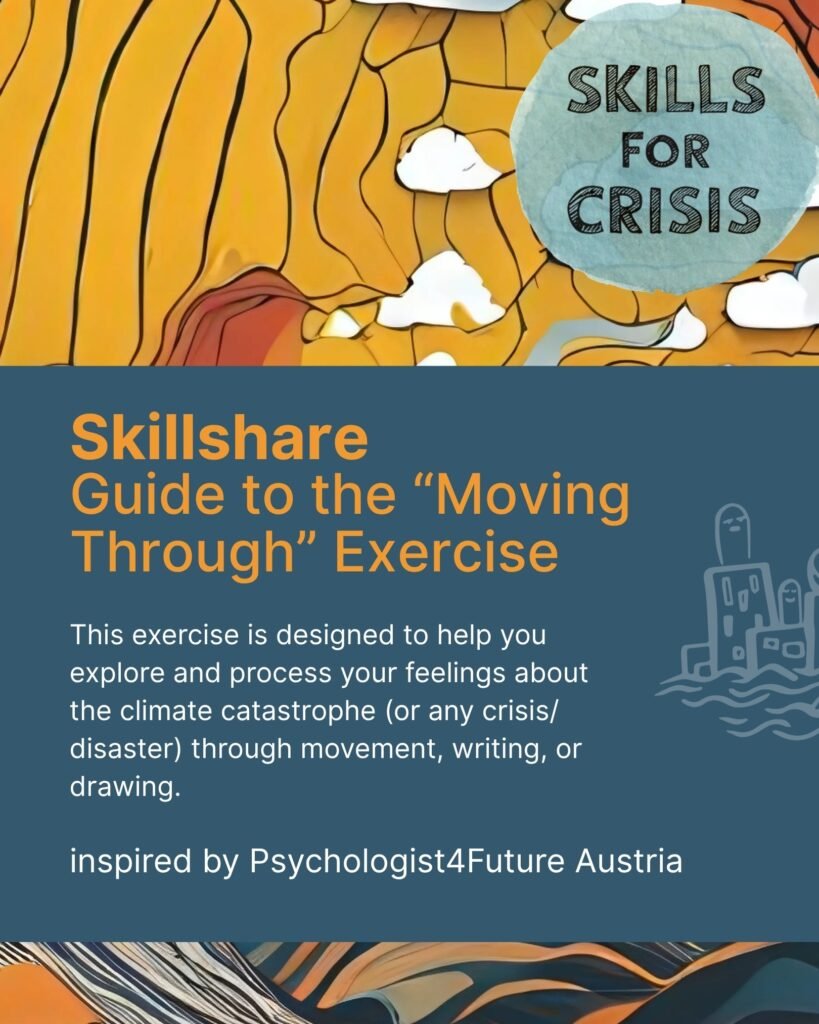
This exercise is designed to help you explore and process your feelings about the climate catastrophe (or any crisis/disaster) through movement, writing, or drawing.
Imporant Disclaimer
- Your Wellbeing Comes First:
Only participate if you feel emotionally safe and comfortable. If at any point you feel overwhelmed, you can pause or stop the exercise. You are encouraged to do what feels good for you—take a break, have a cup of coffee, or simply observe until the debrief. - Intensity Warning:
This exercise may bring up strong emotions. It’s normal to feel things you don’t usually notice. Please be gentle with yourself, stop or even don´t start the exercise if you do not feel grounded.
Step-by-Step Instructions
1. Prepare Your Space (1-2 minutes)
- Find a quiet, comfortable area where you can move freely or sit to write/draw.
- Gather any materials you might need: paper, pen, markers, or just clear some space to move.
2. Set Your Intention (1 minute)
- Take a deep breath.
- Remind yourself that you are here to gently explore your feelings, not to judge or fix them.
3. Begin the Exercise (10 minutes)
Express Freely:
Let your body, pen, or movements express whatever comes up. There’s no right or wrong way to do this.
Choose Your Expression:
Decide if you want to write, draw, move, dance, or combine these methods.
Lower Your Barriers:
Try to relax and let your guard down, as much as you feel comfortable.
Ask Yourself:
- What do I feel regarding the climate catastrophe (or crisis/disaster)?
- Where do I feel this in my body?
- When do these feelings appear?
4. Dialogue With Your Feelings (2-3 minutes)
- If you can identify a particular feeling, ask yourself:
- Is there anything I want to say to this feeling?
- For example: “I hear you,” “You are welcome here,” “I will take care of you,” etc.
- You can say it aloud, write it down, or express it through movement.
After the Exercise
5. Transition (Signal: Music)
- After 10 minutes, music will play to signal the end of your solo exploration.
6. Share in Pairs (15 minutes)
- Pair up with two other participants.
- Take turns sharing your experience, listening to each other without judgment.
7. Group Debrief
- Rejoin the larger group.
- Discuss strategies for handling, reacting to, and coping with the feelings that came up during the exercise.
Final Notes
- Participation is Voluntary:
You can choose to participate in any or all parts of the exercise. - Support is Available:
If you need support at any time, please reach out to the facilitator or a trusted person.
Feel free to use or adapt this guide for your session! (This method is inspired by Psychologist4Future Austria. Thank you for the exchange)
Workshop outcomes – case studies
Case Study 2 – Flooding in Ahrtal
Workshop Concept for your groups
From the experiences and content of the online and offline Workshop, we produced a Workshop Concept to share with you and your groups. It contains methods and proposals for timeslots and breaks.
Please address where you got it from, feel free to send us feedback or make your own changes. There is a short version and a longer one. You can find it in the “Resources” section or by a click on the following link: https://skills4crisis.org/resource/workshop-concept-solidarity-in-the-face-of-climate-disasters-mutual-aid-as-an-antidote/ Below the pdf-Reader you can find the button to download the pdf.
Solidarity in the Face of Climate Disasters: Mutual aid as an antidote – 6 hours
Solidarity in the Face of Climate Disasters: Mutual aid as an antidote – 3 hours
Facilitator(s)
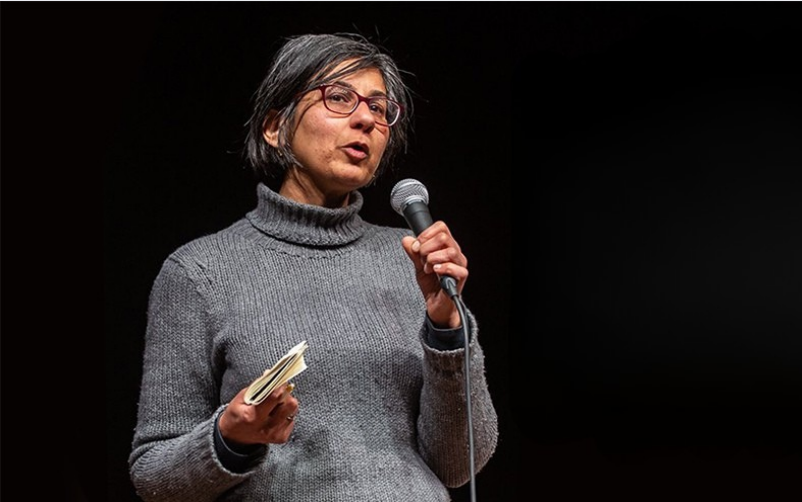
Payal Parekh has been working to protect people and the planet since she was 19 in her native India, United States and now in Switzerland, where she resides. She holds a Ph.D. in climate science and ocean chemistry from the Massachusetts Institute of Technology and the Woods Hole Oceanographic Institution.
Payal Parekh is an activist with the science to back it up. After leaving scientific research, she has worked in leadership positions at a number of international environmental NGOs, while staying active in grassroots movements on the ground. Her unique experiences have shaped how she works and her political vision. She believes strongly in collective action and designs campaigns that draw heavily on organizing, mobilizing and mass actions.
Payal Parekh also believes that movements can only grow if we meet people where they are at and speak and write in a way that is not speaking to the converted.
Jayda Sauseng is part of the Skills4Crisis project team. Their main task is networking and establishing international cooperation for the partner organisation Humus, as well as organizing the skills share event Tipping Points.
About the project
The ‘Skills for Crisis’ project acknowledges that ecological tipping points, social collapse and multiple crises have been reached. They will be and already are our reality. The world as we know it is coming to an end. Embracing this thought, faces us as individuals, but also our communities with questions, feelings and processes, forcing us to leave our known ground of “solving” and “saving”.
Together we want to explore what civil society organisations, our communities and social movements need in order to react and act in Solidarity to crises. We want to learn from the past, support healing in the present and shape the way we enter the future.
For one year, we will collect and discuss existing knowledge and practices about crises and develop workshops based on five streams of thoughts.
Stream of Thought

Facing Extreme Weather is one of the 5 Streams of Thoughts we are following throughout the project. The Illustrations show a crisis and its Solidarity alternative. Drawing by Fine / Educat Kollektiv.